
When I started analyzing GoDaddy hosting pricing, one thing became clear very quickly: the price you see on the landing page is rarely the full story.
Like many hosting providers, GoDaddy advertises attractive introductory prices designed to encourage new customers to sign up. At first glance, these promotional offers can appear very competitive. However, once I looked deeper into how GoDaddy hosting plans work over time, I realized that understanding the actual long-term cost of hosting requires more than just checking the initial price.
Many users researching GoDaddy hosting pricing are trying to answer practical questions such as:
-
How much does GoDaddy hosting really cost after the first term?
-
Are there additional costs for features like backups or security?
-
What limitations exist within each hosting plan?
Hosting reviewers often point out that pricing structures in the hosting industry can sometimes be confusing because promotional discounts, add-ons, and renewals can change the final cost significantly.
In this article, I’ll break down how GoDaddy hosting pricing works in real-world scenarios, including introductory prices, renewal costs, potential extra charges, and the limitations users should understand before choosing a plan.
How GoDaddy Hosting Pricing Works: Introductory Prices vs Standard Pricing
When I first looked at GoDaddy hosting plans, the introductory prices appeared very attractive. These promotional offers are commonly displayed on the main hosting sales pages and are often designed to encourage new customers to sign up for longer billing terms.
However, what many users eventually discover is that these prices usually apply only to the first billing cycle.
Introductory pricing works by offering a temporary discount on the hosting plan. After the initial term ends, the plan renews at the regular price, which is typically higher than the promotional rate.
This pricing structure is widely used across the hosting industry, but it can still catch some users off guard if they focus only on the initial monthly cost shown during signup.
From my observation, understanding the difference between introductory and standard pricing helps users evaluate the true long-term cost of hosting.
GoDaddy Hosting Plans and Pricing Breakdown
GoDaddy offers several types of hosting services, each designed for different types of websites. The pricing varies depending on the features and server resources included in each plan.

To better understand how GoDaddy hosting pricing aligns with different website needs, it helps to look at the general hosting categories.
| Hosting Type | Typical Website Use | Pricing Characteristics |
|---|---|---|
| Shared Hosting | Personal websites, blogs, small businesses | Lowest entry price but shared resources |
| WordPress Hosting | WordPress websites and blogs | Preconfigured environment for WordPress |
| VPS Hosting | Growing websites with higher traffic | Dedicated virtual resources and greater control |
| Dedicated Hosting | High-traffic websites or complex applications | Highest cost with full server resources |
From my perspective, GoDaddy hosting pricing can work well for users who want a simple starting point, especially for small websites or beginner projects.
However, as websites grow and require more resources, it becomes important to evaluate how the hosting plan’s resource limits and additional features influence the overall cost.
Understanding both the advantages and limitations of GoDaddy’s pricing model helps website owners make a more informed decision about whether the platform aligns with their long-term hosting needs.
GoDaddy Renewal Pricing: What Happens After the First Term?
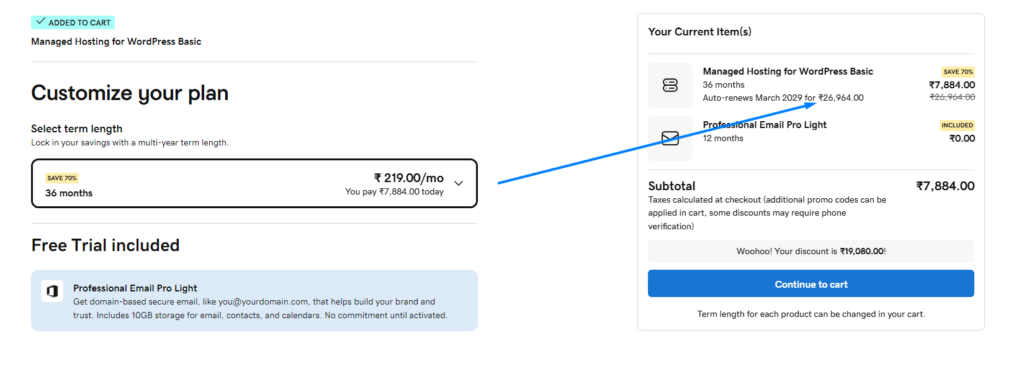
One of the most common questions I see when people research GoDaddy hosting pricing is what happens after the promotional period ends.
After the initial billing term, hosting plans typically renew at the standard price. This renewal price is usually higher than the introductory rate. While price is one factor, it’s also important to consider the uptime and reliability of your hosting service for the long-term. Learn more about GoDaddy’s uptime performance in our GoDaddy Hosting Uptime and Reliability article.
From a practical standpoint, this means the first year of hosting may appear inexpensive, but the total cost over multiple years can increase significantly once standard pricing applies.
Many hosting reviewers recommend calculating the multi-year cost of hosting rather than focusing only on the first year.
For example, when comparing hosting providers, it can be helpful to estimate:
-
the cost of the initial term
-
the expected renewal price
-
the total cost over two or three years
This approach provides a clearer understanding of the long-term value of a hosting service.
Hidden Costs and Optional Add-Ons in GoDaddy Hosting
While reviewing GoDaddy hosting pricing, I also noticed that some features are offered as optional add-ons rather than being included automatically in basic plans.
These add-ons can sometimes increase the overall cost of hosting depending on which features a website requires.
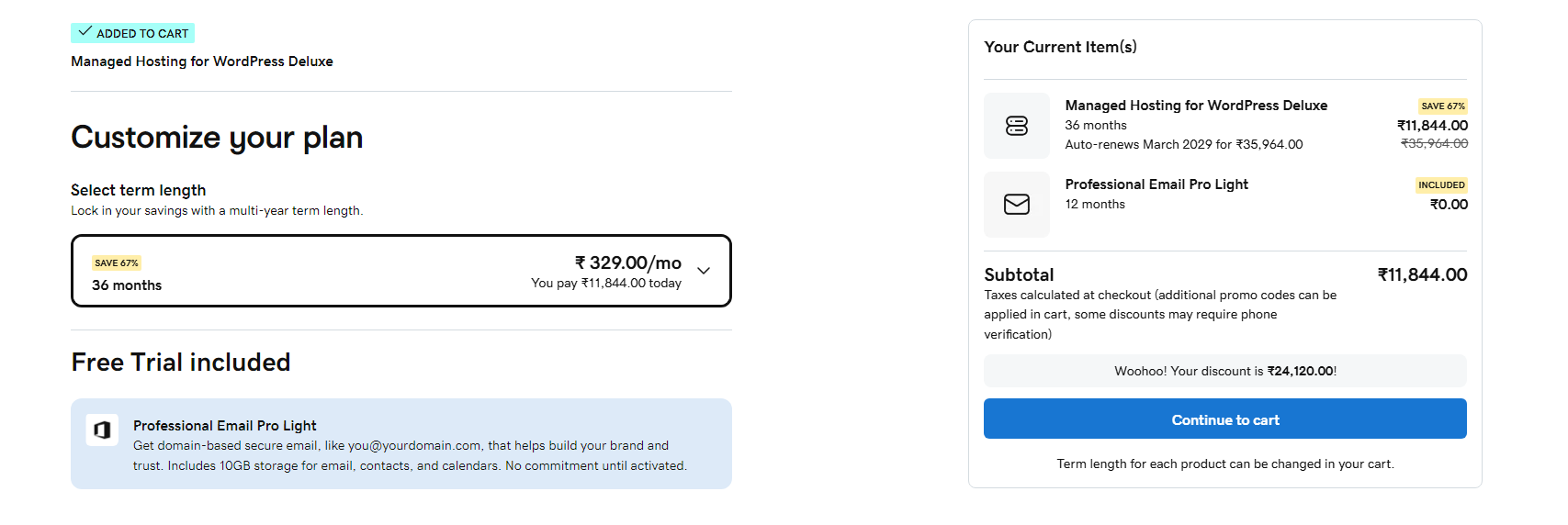
Actually signed up on godaddy:
Additional Added without signup:
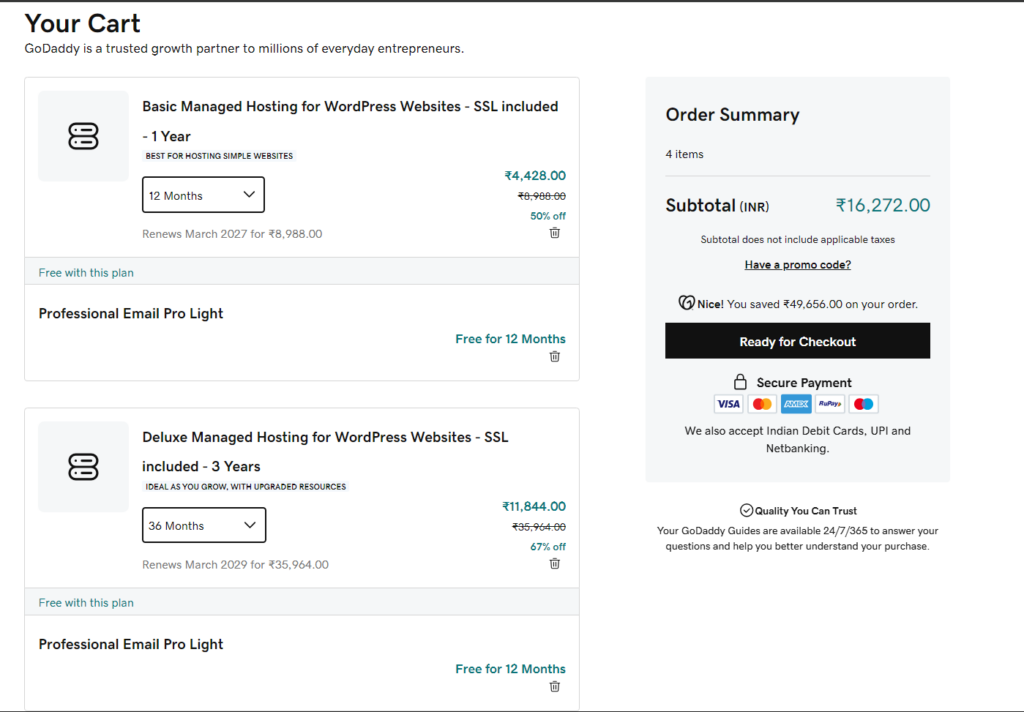
Some commonly offered extras include:
Security Features
Many website owners choose additional security tools to protect their sites from malware or unauthorized access.
Security add-ons may include features such as website monitoring, malware scanning, or enhanced protection services.
Backup Services
Regular backups help protect website data in case of unexpected problems.
Although backups are important for website management, some hosting plans offer automated backup tools as optional upgrades.
Email Hosting
Professional email services linked to a domain are another feature that may be offered separately depending on the hosting plan.
Businesses often choose email hosting solutions to create branded email addresses associated with their domain.
When evaluating hosting pricing, it is useful to consider which of these features are essential and which ones may not be necessary for a specific website.
User Review: Gabrielle Preuss – US
The Issue: The “Hidden” Better Deals
I went through the standard process: bought my domain, browsed the hosting plans, and selected the most affordable one that seemed to fit my needs. However, the moment I finished my purchase and returned to the site “just for fun,” I was suddenly presented with entirely different plans.
These “new” plans were not only better but included features that were missing from my initial checkout – specifically integrated marketing tools and more comprehensive features for a similar or better value. It felt like the “good” options were intentionally hidden or gated until I had already spent money.
GoDaddy Hosting Resource Limits and Plan Restrictions
When I review hosting pricing, I always look beyond the monthly cost and examine the resource limits attached to each hosting plan. Pricing alone doesn’t tell the full story because the actual value of a hosting plan depends on how many server resources it provides.
In the case of GoDaddy hosting, entry-level plans are designed to be affordable, which means certain technical limits apply. These limits are common in shared hosting environments, but understanding them helps website owners avoid performance issues later.
Some common limitations include:
Website Limits
Some GoDaddy hosting plans restrict how many websites can be hosted within a single account. Entry-level plans may allow only one website, while higher plans allow multiple websites under the same hosting package.
For website owners managing multiple projects, this can influence which plan offers the best value.
Storage and File Capacity
Storage determines how many website files, images, videos, and databases can be stored on the hosting server.
Although many hosting providers advertise large storage limits, the effective usage still depends on the type of content being stored. Media-heavy websites often require significantly more storage than simple informational websites.
CPU and Memory Usage
Another important factor I consider is how server processing power is allocated.
Shared hosting plans distribute server resources among multiple websites. If a website consumes more CPU or memory than the plan allows, the hosting system may temporarily restrict resource usage to maintain stability for other websites on the same server.
When this happens, website owners may notice:
-
slower page loading speeds
-
delayed server responses
-
performance warnings from the hosting dashboard
User Review: Sachin Kumar – IN
Don’t buy godaddy VPS server. i bought 1 VPS server daily my website getting down and restart seerver 20-25 time. Always RAM and CPU ussage 99% full. I run only 1 website in godaddy VPS server. Also they don’t provide support on VPS server because support team tols us they have limited access.
Traffic Handling and Performance Restrictions
While many hosting providers advertise “unmetered bandwidth,” there are still practical limits to how much traffic shared hosting environments can handle smoothly.
If a website receives a large surge of visitors within a short period, the hosting server may struggle to process all incoming requests. In these situations, upgrading to a higher-tier hosting environment often improves performance stability.
User Review: Giuseppe Lo Piccolo – AU
At the beginning, the service looks cheap and appealing, especially with discounts offered when you sign up or during sales calls. However, once your website is live, that’s when the real problems start. I experienced slow page loading, dragging performance, upload issues, and general instability that I never had with previous hosting providers.
When considering GoDaddy hosting pricing, it’s important to understand the potential impact on your website’s performance. The limitations of entry-level plans can sometimes cause slow page loading or even crashes, particularly during high-traffic events. If you’re interested in how GoDaddy hosting actually performs in real-world conditions, check out our detailed GoDaddy Hosting Website Speed Test and Performance article for insights into how their hosting plans handle website speed.
Typical Resource Characteristics in Entry-Level Hosting Plans
| Resource Category | Typical Entry-Level Plan Characteristics | Practical Impact on Websites |
|---|---|---|
| Number of Websites | Usually limited to one site in basic plans | Additional websites may require plan upgrades |
| Storage Capacity | Moderate storage designed for small websites | Large media libraries may require higher plans |
| CPU Processing | Shared across multiple accounts | Heavy scripts may slow down during peak usage |
| Memory Allocation | Limited RAM per account | Complex websites may experience slower performance |
| Bandwidth | Often advertised as unmetered | High traffic spikes may affect performance stability |
From my perspective, understanding these limits is important because it helps website owners choose a hosting plan that matches their actual needs rather than focusing only on price.
Pros and Cons of GoDaddy Hosting Pricing
After reviewing GoDaddy’s pricing structure and the features included in each plan, I’ve developed a balanced view of how their hosting costs compare within the broader hosting industry.
While GoDaddy offers some advantages in terms of accessibility and introductory pricing, there are also a few limitations that potential users should consider.
Advantages of GoDaddy Hosting Pricing
Affordable entry point for beginners
One thing I noticed when reviewing GoDaddy hosting plans is that the introductory prices are designed to make it easy for beginners to launch a website with minimal upfront cost.
For individuals starting their first website or small online project, these promotional offers can provide a convenient starting point.
Wide range of hosting options
GoDaddy provides multiple hosting categories that support different website needs. Users can choose between shared hosting, WordPress hosting, virtual private servers, and dedicated servers.
This flexibility allows websites to upgrade hosting environments as they grow.
Simple pricing structure for entry-level plans
For beginners who are not familiar with hosting infrastructure, GoDaddy’s plan categories are relatively straightforward. Most entry-level plans focus on essential hosting features that allow websites to get online quickly.
Availability of optional upgrades
GoDaddy also offers additional features that can be added depending on the website’s needs. These upgrades may include security tools, backup solutions, or performance enhancements.
For some users, having optional upgrades allows them to customize their hosting environment over time.
Limitations to Consider
Introductory pricing vs long-term cost
One of the most frequently discussed aspects of GoDaddy hosting pricing is the difference between the introductory promotional price and the standard renewal price.
From my analysis of hosting plans, the long-term cost of hosting can become more noticeable once the promotional period ends.
User Review: Daniel Benjamin – US
GoDaddy has always had great pricing and (up until recently) good customer service, US-based agents, and excellent processes for one-call-fixes in nearly every case. No longer! The past few years, they’ve begun many nasty scams to steal money from customers, and I unfortunately have to have once- or twice-annual battles with GoDaddy for refunds on items that somehow stuck to me without my knowledge when registering a domain
Optional features may increase total cost
While the base hosting plan includes core functionality, some features that website owners may consider essential-such as automated backups or additional security tools-may require separate add-ons.
When these features are included, the total hosting cost may increase.
Resource limits on entry-level plans
As mentioned earlier, entry-level shared hosting plans typically include limitations related to server resources.
These restrictions are common across shared hosting environments, but they can affect websites that experience rapid growth or high traffic.
User Review: Dillon – US
Over the last 2 years, I’ve had recurring performance issues. Recently, these worsened to the point where my sites crash daily with 500 Internal Server Errors every evening. I later learned this was due to a hidden 24-hour resource cap — something GoDaddy never disclosed when I signed up. My websites serve local businesses with low traffic, yet I’m being throttled like I’m abusing the server. This directly contradicts what they advertise.
Performance scalability may require upgrades
Websites that expand significantly in traffic or complexity may eventually require more powerful hosting environments. In such cases, upgrading to VPS or dedicated hosting may provide better performance and resource availability.
Final Verdict: Is GoDaddy Hosting Worth the Price?
From my perspective, GoDaddy hosting pricing can be reasonable for users who want a simple way to launch a website quickly.
The introductory pricing makes it easy for beginners to get started without a large upfront investment. However, it is important to evaluate the long-term cost of hosting, especially when renewal prices and optional features are considered. If you’re looking for a full review of GoDaddy’s features, performance, and customer service, check out our detailed GoDaddy Review
For smaller websites, the pricing structure may still offer acceptable value. But for larger projects that require higher performance or scalability, some users may prefer hosting platforms that include more features in their base plans.
Ultimately, whether GoDaddy hosting is worth the price depends on the specific needs of the website and how the hosting plan fits those requirements.
Conclusion:
After taking a closer look at GoDaddy hosting pricing, I found that the platform follows a pricing structure that is common across much of the hosting industry.
The introductory prices can make hosting appear very affordable at first, but the overall cost becomes clearer when renewal pricing and optional features are taken into account.
For many personal websites and small projects, GoDaddy hosting may still provide acceptable value. However, website owners who want predictable long-term pricing often compare several hosting providers before making a final decision.
Understanding the full pricing structure helps users make a more informed choice about whether GoDaddy hosting aligns with their budget and website requirements.
Frequently Asked Questions
How much does GoDaddy hosting typically cost?
The cost varies depending on the hosting plan, promotional pricing, and selected features.
Why are GoDaddy introductory prices lower than renewal prices?
Introductory discounts are often offered to attract new customers, while standard pricing applies after the first billing period.
Are additional features included in GoDaddy hosting plans?
Some features are included, while others may be available as optional upgrades.
Can hosting plans be upgraded later?
Yes. Hosting plans can typically be upgraded as a website grows and requires more resources.
Does hosting pricing affect website performance?
Pricing often reflects the level of server resources and infrastructure available to the hosting plan.
Is shared hosting the cheapest option?
Shared hosting usually offers the lowest starting price but may include more resource limitations.
Should users compare multiple hosting providers before buying?
Many website owners compare several hosting providers to find the best balance between cost, performance, and features.